Half a Shtof, Dear Sir
How a footnote in Crime and Punishment derailed my reading for twenty minutes.


How a footnote in Crime and Punishment derailed my reading for twenty minutes
I started reading Crime and Punishment with the appropriate amount of respect for a Russian classic: cheap paperback, pen in hand, and the vague expectation that Fyodor Dostoevsky was going to make me suffer.
I did not expect the first thing to completely derail me to be a unit of measurement.
Enter Marmeladov.
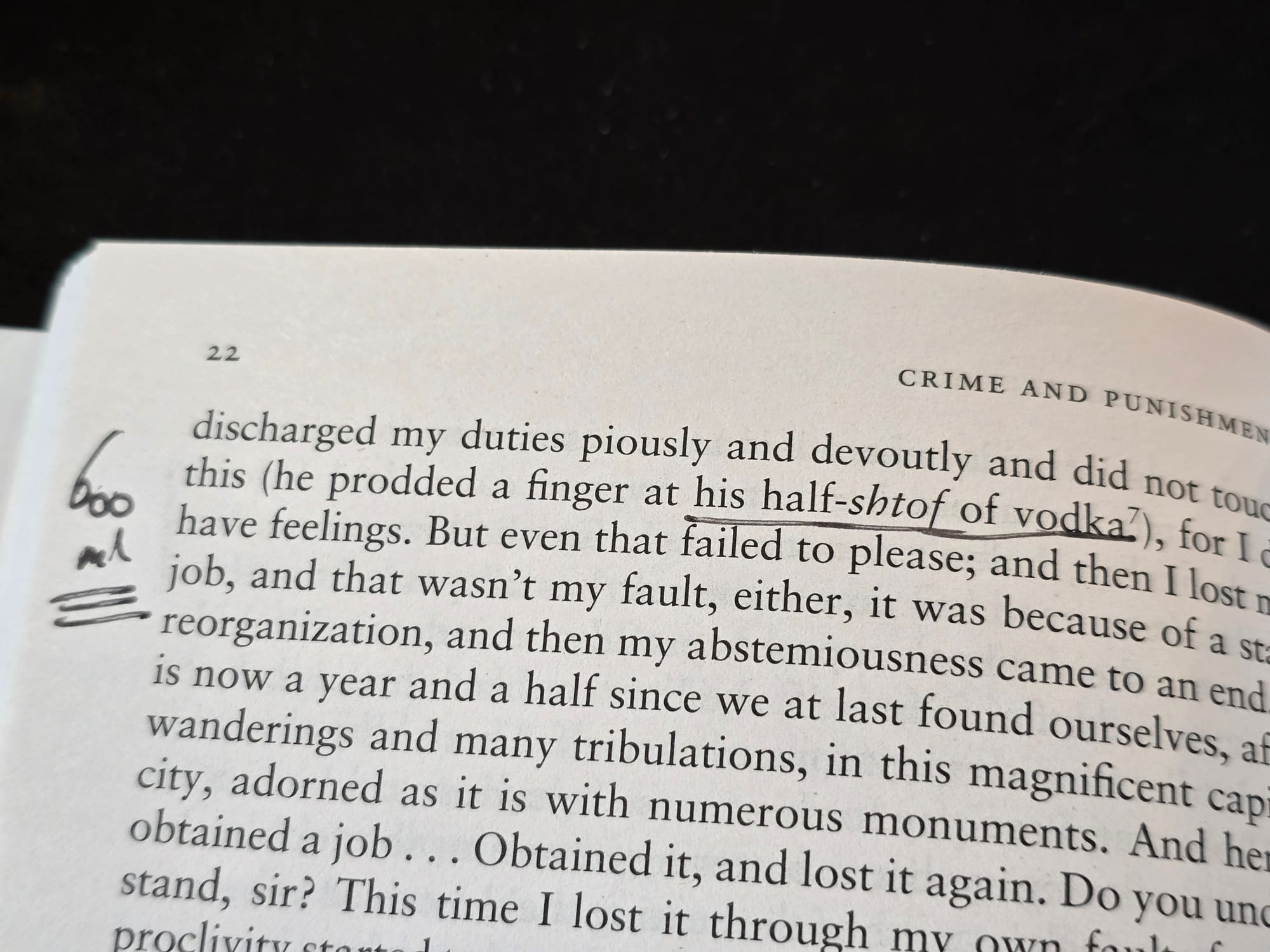
Raskolnikov wanders into a tavern and meets a man who has apparently decided that a random student is precisely the audience required for the complete story of his ruined life.
Marmeladov is poor. His family is poorer. He has been sleeping in hay. His wife is ill. His daughter has been driven to prostitution to put food on the table.
And Marmeladov drinks.
Not because drinking makes things better, mind you. The man is remarkably clear about that. Drinking makes everything worse. He drinks because he suffers, and then suffers because he drinks.
He is basically giving a TED Talk titled:
My Life of Sorrow and Regret, and Drinking
The graph has one line. It goes up.
More drinking → more suffering.
Marmeladov's conclusion?
Excellent.
Because, as he explains with the magnificent theatricality of a man who has apparently rehearsed his own misery many times, he drinks because he desires to suffer doubly.
This is already peak Dostoevsky. I had intended to read perhaps a page. Instead I was sitting there thinking about addiction, shame, self-punishment, and the deeply human tendency to keep doing the thing that hurts because changing is somehow even more terrifying.
But then Dostoevsky casually mentions that Marmeladov has consumed half a shtof of vodka.
Fine.
Half a shtof.
My brain translated this automatically into something like half a shot. Some quaint old Russian drinking measure. A little vodka. The man is drunk. Message received.
Except there was a footnote.
And I have learned to respect footnotes.
So I flipped to footnote 7.
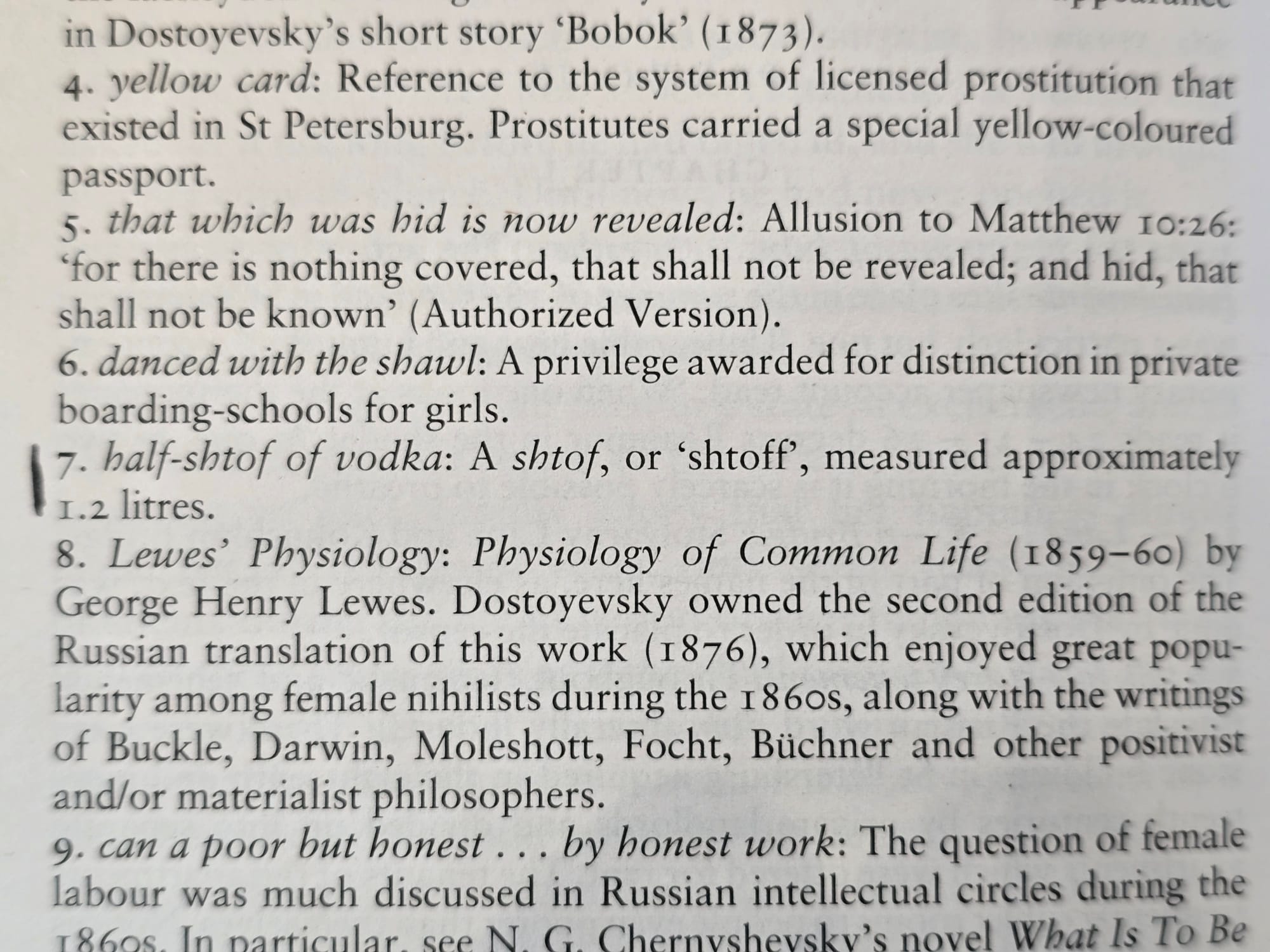
A shtof is approximately 1.2 litres.
Dear sir.
Dear sir.
Half a shtof is six hundred millilitres of vodka.
This man has not “had a drink.”
This man has consumed most of a modern bottle of vodka and is now sitting in a tavern delivering an astonishingly coherent philosophical analysis of his own moral degradation to a complete stranger.
Suddenly the entire scene changed.
“I drink because I desire to suffer doubly” stopped sounding like merely a wonderfully dramatic thing for a drunk Russian to say.
My brother in Christ, you have provided experimental evidence.
And this is where my reading of Crime and Punishment stopped for about twenty minutes.
Not because I was confused.
Because I had to chew on a shtof.
The footnote changed the scene
This is one of my favourite things about reading old books.
Sometimes a word is just a word.
Sometimes you can infer enough from context and keep moving. A carriage is some kind of carriage. A coin is some amount of money. A measure of vodka is presumably a measure of vodka.
And then a footnote quietly reaches out from the bottom of the book and says:
No, no. You need to understand this one.
Without the footnote, Marmeladov drank some vodka.
With the footnote, Marmeladov drank 600 fucking millilitres of vodka.
That's not trivia anymore. That's character information.
It also makes his eloquence hilarious.
No drunk man should be this coherent.
At that point I would expect him to be explaining to Raskolnikov why the table has insulted his mother. Instead, Marmeladov is constructing paragraphs. He has rhetorical structure. Themes. Callbacks. A thesis.
The man is three slides away from taking questions from the audience.
But the more I read, the more the strange coherence started to make sense.
Perhaps these aren't thoughts Marmeladov is discovering while drunk.
Perhaps these are thoughts he has had a thousand times.
He knows exactly what he is doing.
He knows he drinks because he suffers.
He knows drinking causes more suffering.
He knows his family suffers because of him.
He knows he is ashamed.
And still he drinks.
That's much darker than simple ignorance.
The known misery
There's an uncomfortable little machine hiding inside Marmeladov's story.
You suffer, so you do something that gives temporary relief.
That thing makes your situation worse.
Now you suffer because of the original problem and because of what you did to escape it.
So you do the thing again.
At some point, stopping becomes terrifying because stopping doesn't merely mean giving up the harmful behaviour.
It means facing everything underneath it.
The original pain is still there. Now the consequences are there too. The shame is there. The people you've hurt are there. And the familiar mechanism you've been using to avoid all of that is suddenly gone.
The misery may be awful.
But it is known misery.
You know how to be this person.
Changing means finding out who you are without it.
And maybe failing.
So Marmeladov can understand his situation perfectly and remain trapped inside it.
That hit me harder than I expected.
We like to think self-awareness is the breakthrough. Identify the problem, understand the pattern, change the behaviour.
Dostoevsky gives me a man who can explain his destructive feedback loop with extraordinary clarity while actively executing the destructive feedback loop.
Insight is not action.
Sometimes your clever brain is just the lawyer who arrives afterward to explain why you did what you already wanted to do.
Which, incidentally, is an extremely inconvenient thought to encounter shortly before considering whether you should buy “just one” pack of Magic: The Gathering cards.
Why shouldn't I?
Oh.
Oh no.
Fyo has installed diagnostics.
I now own two bookmarks
Anyway, this was supposed to be a short reading session.
One page, I told myself.
Just give Fyodor one page.
Thirty-four pages later I had acquired a working knowledge of obsolete Russian alcohol measurements, annotated several footnotes, and added a second bookmark specifically so I could move between the novel and its notes without losing either place.
I am now annotating the documentation for the novel.
This paperback is doomed.
By the time I finish it, I want it to look like it has been through St. Petersburg itself: cracked spine, margins full of accusations, coffee stains, perhaps the occasional trace of whiskey.
Not half a shtof, though.
I've read the documentation.
And someday, if I finish Crime and Punishment and love it, perhaps I'll buy one of those beautiful pristine clothbound editions and put it beside the destroyed paperback.
Someone will point at the battered copy.
“Nice book. Read it?”
I'll look into the distance.
“We had a conversation.”
Then I'll grab something else from the shelf.
Anyway.
Look at this illustrated Hobbit.
A shtof is approximately 1.2 litres.
That's the whole blog post, really.